

At The 80/20 Institute, profitable growth is never accidental. It is earned through focus, discipline, and execution.
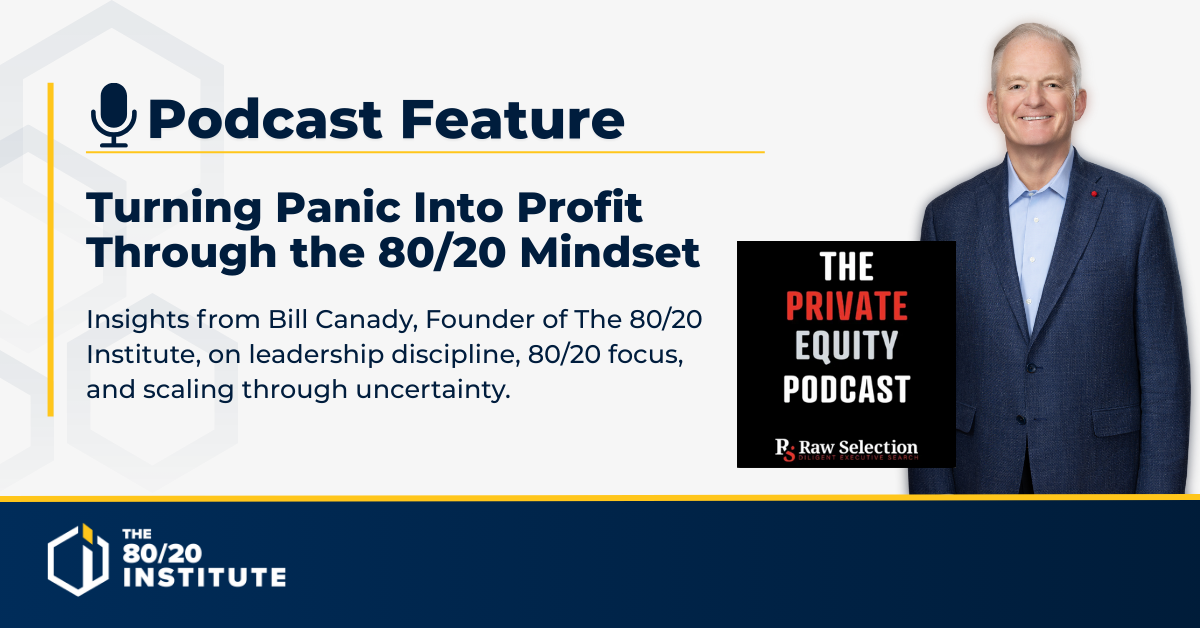
These principles were discussed by Bill Canady, Founder and Chairman of The 80/20 Institute, during his interview with Vaishali Jain on SarderTV, where the conversation focused on how the 80/20 Principle shapes leadership, decision-making, and the ability to scale organizations through uncertainty.
What follows is not a personal reflection. It is the operating philosophy embedded inside organizations to convert chaos into clarity and sustained financial performance.
Growth Must Be Earned
Across more than three decades of leading companies through expansion, contraction, and transformation, one reality has remained consistent: growth is not guaranteed.
As shared on SarderTV, organizations earn the right to grow only after they demonstrate focus, operational discipline, and leadership alignment. When these elements are missing, scale magnifies dysfunction. When they are present, growth becomes repeatable.
This belief is the foundation of the work delivered by The 80/20 Institute and the basis for the Profitable Growth Operating System™ (PGOS).
The 80/20 Principle as an Operating Discipline
At the core of the methodology used by The 80/20 Institute is the 80/20 Principle, originally observed by economist Vilfredo Pareto.
In business, its implications are practical and measurable. A small portion of customers, products, and activities consistently drives the majority of profit and cash flow. Yet many organizations allocate resources evenly or emotionally rather than economically.
The 80/20 Institute applies this principle as a decision filter. Data replaces politics. Value creation determines priority. People, capital, and leadership attention are redirected toward the few areas that truly matter.
This shift requires courage, because it demands stopping activities that feel familiar but no longer create value.
Zero-Up Thinking: Rebuilding for What Matters Most
One of the disciplines discussed during the SarderTV interview is Zero-Up Thinking, a cornerstone of PGOS.
Leaders are asked to imagine rebuilding the business from scratch using the same resources. The question is simple: where would investment be placed first to maximize profit and resilience?
The answer is almost always the same. Focus would begin with the most profitable customers, strongest products, and most capable teams.
Zero-Up Thinking eliminates attachment to legacy complexity. It forces clarity, sharpens priorities, and creates the discipline required to scale.
The Three Leadership Roles Required for Scale
Sustained growth requires balance. No single leadership style is sufficient on its own.
High-performing organizations consistently balance three roles:
-
The Visionary, who defines direction and purpose
-
The Operator, who translates strategy into execution and daily performance
-
The Prophet, who brings specialized expertise and accelerates learning and transformation
When these roles are aligned, strategy becomes action and learning becomes embedded. When one is missing, execution slows and momentum erodes.
Discipline and Resilience Shape Execution
Long before boardrooms and executive roles, military service instilled the principles that continue to shape this leadership philosophy: discipline, accountability, teamwork, and respect.
As emphasized during the SarderTV conversation, these traits are not situational. They are constants. Effective leaders finish what they start, pay attention to details, and take responsibility for outcomes.
Execution under pressure is not learned during crisis. It is built long before it arrives.
Data Over Drama, Speed Over Perfection
Leaders guided by The 80/20 Institute are decisively data-driven, but never paralyzed by analysis.
Too little information leads to guessing. Too much delays action. Effective leadership operates in the middle ground—using enough data to move decisively and adjusting quickly as new insight emerges.
This approach has proven critical during periods of economic disruption, when speed, focus, and course correction matter more than certainty.
Progress comes from action, learning, and refinement, not from waiting.
Culture Enables Strategy to Work
Strategy alone does not create results. Culture determines whether execution happens.
Organizations supported by The 80/20 Institute build cultures grounded in psychological safety, accountability, and continuous improvement. People must feel safe to speak honestly, experiment responsibly, and learn from failure.
When fear is removed and expectations are clear, teams engage fully. Strategy stops being theoretical and becomes operational.
AI as an Accelerator, Not a Replacement
As discussed on SarderTV, artificial intelligence is a powerful amplifier of leadership effectiveness when used correctly.
AI processes vast data sets rapidly, freeing leaders to focus on judgment, insight, and strategy. But AI does not replace leadership. It reflects it.
Clear thinking, disciplined questions, and sound decision-making remain human responsibilities. Technology accelerates outcomes only when leadership direction is clear.
Earning the Right to Grow
Before pursuing expansion, leaders guided by The 80/20 Institute consistently ask three foundational questions:
-
Are customers being served with excellence?
-
Are people aligned, capable, and accountable?
-
Is the operational foundation strong?
Growth magnifies what already exists. Organizations that strengthen their core scale sustainably. Those that ignore fundamentals collapse faster.
From Panic to Profit Is a System
The message shared during the SarderTV interview aligns directly with the mission of The 80/20 Institute.
Turning panic into profit is not about inspiration or intuition. It is about clarity, focus, and disciplined execution around the vital few.
Simplify complexity.
Prioritize the top 20 percent.
Embed accountability.
Act decisively under uncertainty.
That is the 80/20 mindset in practice.
That is the Profitable Growth Operating System™.
That is how The 80/20 Institute helps leaders move from uncertainty to sustained performance.