

What is 80/20?
Focus on the few things that drive the most results.
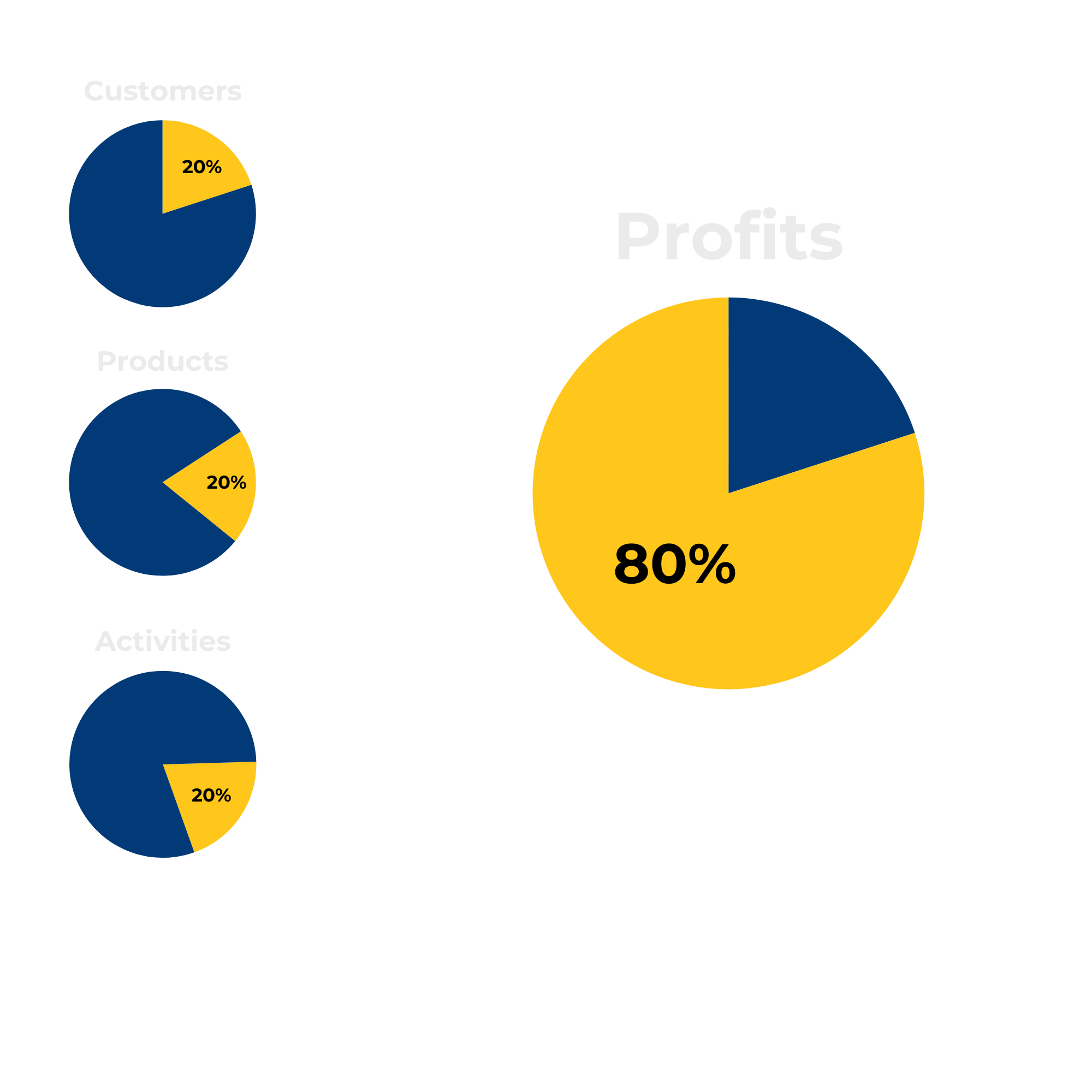
The 80/20 principle, also called the Pareto Principle, shows that roughly 80% of results come from 20% of causes. In business, this means a small portion of products, customers, or actions often produce the majority of revenue and profit.
Identify complexity, simplify your operations, and earn the right to grow.
The Power of 80/20 in Business
When you consistently apply the 80/20 principle, the impact is transformative. It creates clarity, reduces costs, and builds a stronger, more scalable business.

Increased Profitability
By focusing on the most valuable products and customers, you naturally increase your margins and overall profit.

Greater Productivity
You and your team stop wasting time on low-impact tasks and redirect that energy toward activities that truly move the needle.

Reduced Complexity & Stress
Eliminating or automating the "trivial many" simplifies your operations, reduces firefighting, and creates a calmer, more controlled work environment.

Enhanced Customer Satisfaction
By focusing on your best customers, you can serve them more deeply, leading to greater loyalty, more referrals, and higher lifetime value.

Sustainable Growth
80/20 builds a strong foundation, allowing you to scale your business intelligently instead of just adding more complexity.

The Evolution of a Simple Idea
How 80/20 Went From Insight to Operating System
A 19th-century economic pattern became the playbook for modern profitable growth.
Make 80/20 Integral Part Of Your Business
The 80/20 rule is clear: In most businesses, 80% of profits stem from a mere 20% of customers, products, and activities.
Identifying and focusing on these vital elements is the key to major growth and increased profitability.
Learning Library
80/20 is The Simple Math of Maximum Profit
80/20 Eliminates Complexity
80/20 Empowers Your Entire Team
The Power of Strategic Quitting
Aligning Your Team on Real Value
Focus At Every Level
The Ultimate Profit Generator
Discover How 80/20 builds the confidence
Frequently Asked Questions
While the principle applies to any business, its power is magnified in complex environments like manufacturing and logistics. Here, we address the specific questions we hear most often from leaders like you.
-
STRATEGY & IMPLEMENTATIONS
-
FINANCIAL & INVESTMENTS
-
SALES, CUSTOMERS & PRODUCTS
-
DATA QUESTIONS
-
OPERATIONS & MANUFACTURING
STRATEGY & IMPLEMENTATIONS
It starts as a project but delivers its greatest value when it becomes an ongoing cultural mindset. The initial analysis provides the big wins and creates momentum. The long-term goal is to embed 80/20 as the "operating system" for the business, where everyone from sales to the shop floor is constantly asking: "Is this a high-value, 20% activity?"
The initial data analysis and strategic insights can be completed in a matter of weeks. Businesses often see tangible results on the P&L—from pricing adjustments on unprofitable accounts or initial product simplification—within the first 90 days. The more significant, structural changes naturally take longer but deliver exponential returns.
With the data. The 80/20 process removes opinion and replaces it with objective facts about profitability. When you present a clear, data-backed case that shows exactly where money is being lost to complexity and provides a clear roadmap to higher profits, even the most skeptical stakeholders become champions.
Every business leader feels their company is unique, and it is. However, the principle of imbalance is universal. We've seen it apply across dozens of industries. Your "20%" will be different from anyone else's, but it's there. Our process doesn't apply a generic solution; it uses the 80/20 lens to find the unique, high-leverage opportunities inside your specific business.
FINANCIAL & INVESTMENTS
SALES, CUSTOMERS & PRODUCTS
DATA QUESTIONS
OPERATIONS & MANUFACTURING
Ready to Improve
Revenue, Margin, and EBITDA?
Learn how organizations apply 80/20 thinking to achieve consistent, sustainable results.