

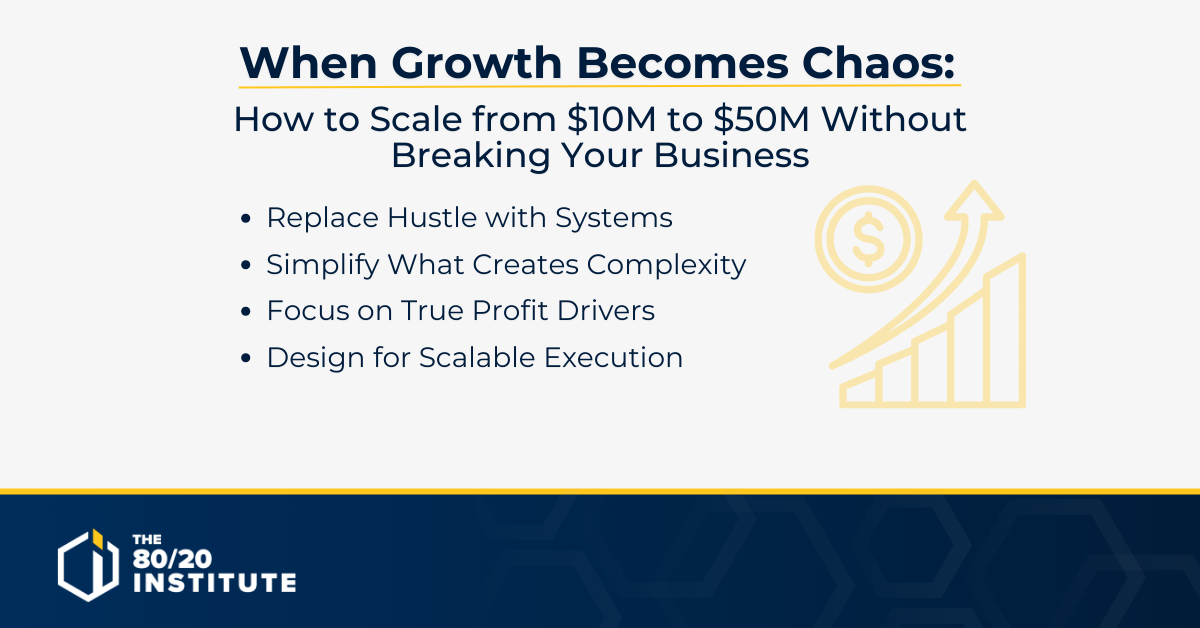
For many business leaders, growth feels exciting; until it doesn’t.
Revenue is climbing. The pipeline looks strong. The team is working harder than ever. And yet… profit is inconsistent, cash is tight, and execution feels chaotic.
You’re no longer building the business. You’re chasing it.
Many founders describe it the same way: “We caught the car. Now we don’t know how to drive it.”
This is Chaos Growth (scaling without systems).
The $10M Problem
At $1M–$10M in revenue, hustle works.
The founder is involved in everything. Decisions are fast. People wear multiple hats. Problems get solved through effort and heroics.
But somewhere between $10M and $50M, the rules change.
- Informal communication stops working.
- Processes break under volume.
- Middle management becomes inconsistent.
- Complexity explodes—more customers, more SKUs, more exceptions.
- Profit margins shrink despite higher sales.
The habits that created growth start to destroy it.
The Hidden Cost of Hustle Culture
Hustle feels productive. It rewards speed, reactivity, and heroic problem-solving.
But hustle doesn’t scale.
When every issue requires escalation…
When priorities change weekly…
When your best people are constantly firefighting…
You don’t have a growth engine. You have organized stress.
And stress erodes margins.
Overtime increases. Errors multiply. Customer experience becomes inconsistent. Leadership attention fragments. Working capital balloons.
Revenue rises. Profit leaks.
The Shift: From Hustle to Systematic
To scale from $10M to $50M, you must evolve from a person-dependent business to a system-dependent business.
This doesn’t mean bureaucracy. It means clarity.
Clarity around:
- Which customers truly drive profit.
- Which products deserve focus.
- Which activities create disproportionate value.
- Which processes must be standardized.
- Which decisions should move down the organization.
This is where the 80/20 principle becomes transformational.
Using 80/20 to Tame Chaos
In almost every growing business:
- 20% of customers generate 80% of profit.
- 20% of products create the most complexity.
- 20% of problems consume 80% of leadership time.
Yet growing companies typically add more—more products, more exceptions, more meetings—when what they need is focus.
Applying 80/20 systematically allows you to:
- Simplify the portfolio: Eliminate low-margin, high-complexity offerings.
- Refocus sales: Double down on your most profitable segments.
- Standardize core processes: Make the “right way” the default way.
- Design scalable decision rights: Reduce dependency on the CEO.
- Free leadership capacity: Shift from firefighting to strategic thinking.
Scaling isn’t about doing more. It’s about doing fewer things better.
The CEO’s Real Job at $50M
At $10M, your job is to push.
At $50M, your job is to architect.
You must design a business that performs without your constant intervention.
If revenue is growing but systems are cracking, don’t celebrate too early. Growth without structure amplifies weaknesses. Every inefficiency becomes more expensive at scale.
The companies that scale profitably are not the ones that hustle harder.
They are the ones that build systems early, simplify aggressively, and institutionalize focus.
If your growth feels chaotic, it’s not a sign to slow down.
It’s a sign to simplify; and build the operating system your next stage requires.
How The 80/20 Institute Can Help
At The 80/20 Institute, we partner with leadership teams to simplify complexity and realign the business around what truly drives profit and cash flow. By rigorously applying the 80/20 principle, we pinpoint the customers, products, and activities that create disproportionate value; and address or remove those that drain resources. The outcome: improved margins, healthier cash flow, and an organization that operates smoothly without constant executive intervention.
If the challenges in this article sound familiar, the first step is gaining clarity.
Book a call with us to uncover where value is being generated, where it’s being lost, and how to design a simpler, more profitable, and scalable business.