

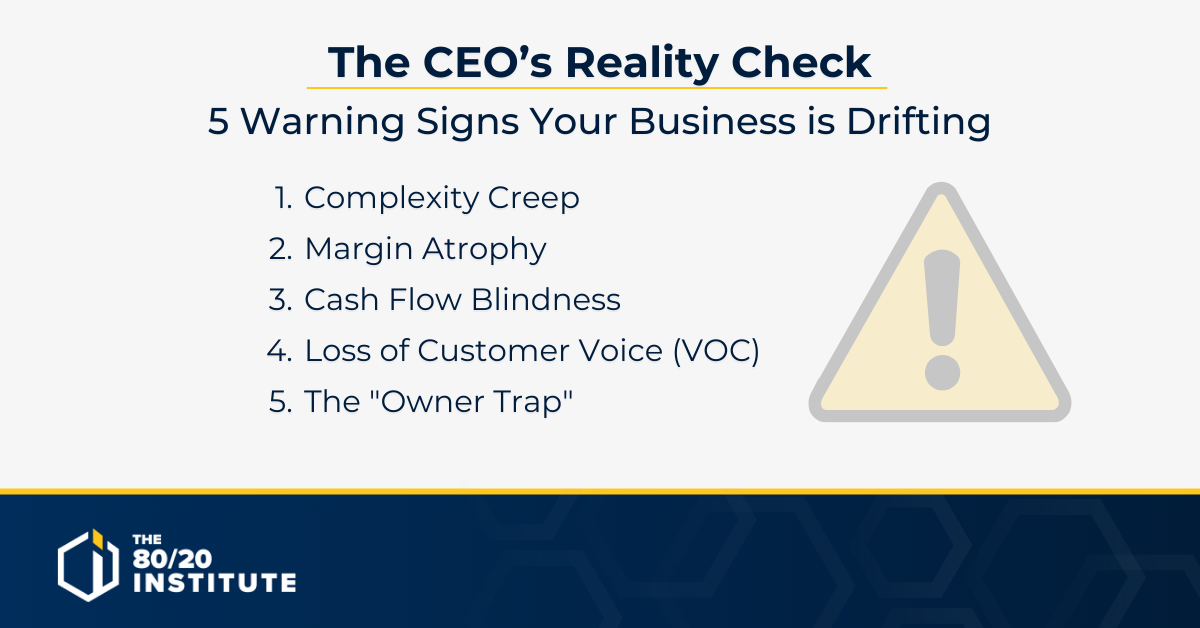
Many businesses don’t fail loudly, they fail quietly. While sales grow, teams stay busy, and dashboards look “mostly fine.” The real warning signs often show up beneath the surface, in operations, margins, and leadership dynamics.
If you recognize several of the signals below, your business may be underperforming in ways that will eventually limit growth; or worse, trigger a sudden crisis.
1. Complexity Creep
Are you adding new products, features, or service tiers just to satisfy the loudest customer in the room? If your SKU list is expanding while your bottom line remains flat, you are suffocating your operational efficiency. Complexity is the silent killer of margin; it introduces “hidden” costs in your warehouse, your sales training, and your customer service that no spreadsheet can fully capture.
Healthy businesses simplify relentlessly. Struggling ones keep saying yes.
2. Margin Atrophy
Revenue is rising, but EBITDA is flat or declining. This is one of the most dangerous illusions in business.
Margin erosion usually means one of two things: you’re winning the wrong business by competing on price instead of value, or your overhead is growing faster than your gross profit. Often, it’s both.
More sales should create operating leverage. If they don’t, growth is actually weakening the company.
3. Cash Flow Blindness
On paper, the company looks profitable. In reality, the bank account tells a very different story.
This disconnect is often caused by bloated assets. Cash is trapped in slow-moving inventory, overdue accounts receivable, or poorly managed working capital. The P&L may look healthy, but cash, the oxygen of the business, is not circulating.
Many businesses don’t run out of profit. They run out of cash.
4. Loss of Customer Voice (VOC)
When was the last time you had a fact-based, deep-dive conversation with your top 20% “A-segment” customers? If leadership decisions are being made based on “gut feelings,” internal assumptions, or what worked five years ago, you have lost the Voice of the Customer. Decisions made in a vacuum almost always lead to resource misallocation.
Strong companies obsess over customer feedback; especially from the customers they want more of, not the loudest ones.
5. The “Owner Trap”
This is the most common sign of a business that has stalled. If every minor decision requires the CEO’s green light, you haven’t built a company; you’ve built a high-stress job for yourself. If the business cannot run with precision for a week without your direct involvement, you are the ultimate bottleneck to your own scale.
The Owner Trap limits growth, exhausts leadership, and dramatically reduces enterprise value.
The Common Thread
These five signs share a root cause: lack of focus. Focus on the right customers. Focus on profitable growth. Focus on cash, simplicity, and decision-making at the right level.
The good news? None of these issues are fatal—if you catch them early and address them deliberately. The bad news? Ignoring them almost always makes them worse.
If your business feels busy but not better, it may be time to look beyond revenue; and listen to what the signals are really telling you.
How The 80/20 Institute Can Help
If you recognized your own organization in any of the five signs above, you aren’t alone, and you aren’t stuck. These “red flags” are simply symptoms of an outdated operating system that was never designed to handle your current scale.
At The 80/20 Institute, we help CEOs and founders trade complexity for clarity. We provide the tools, the discipline, and the expert advisory needed to install the Profitable Growth Operating System (PGOS) within your business.
Whether it’s through our Profitable Growth Accelerator™ (PGA) or the long-term strategic support of The Command Center™, we work by your side to:
- Reclaim your time by eliminating the “Owner Trap.”
- Expand your margins through precision pricing and simplification.
- Unlock trapped cash by optimizing your asset allocation.
- Institutionalize execution so that growth becomes a predictable habit, not a lucky break.
Stop the Drift. Start the Transformation.
Don’t wait for a “stalled” business to become a failing one. Let’s identify the 20% of your activities that will drive 80% of your future success.
Take command of your growth today.