

A business crisis rarely arrives overnight. It creeps in through declining revenue, shrinking margins, eroding share, until one day survival is on the line.
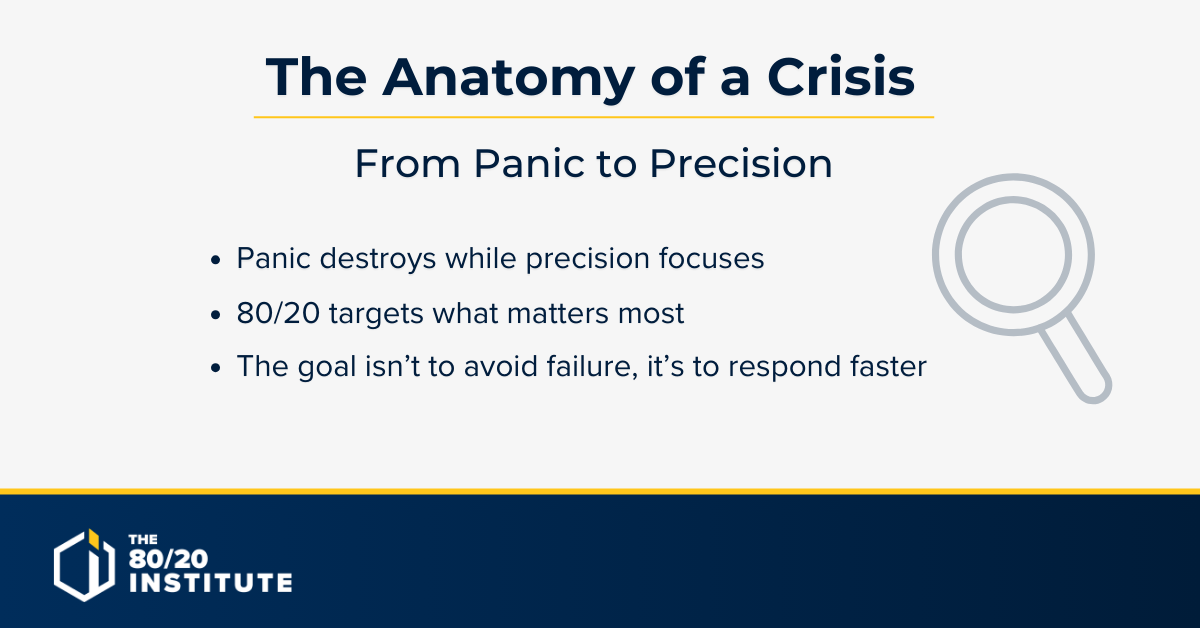
In that moment, leaders face a choice: react with panic or respond with precision.
Panic looks decisive: across-the-board cuts, hiring freezes, layoffs. But it destroys value because it treats everything as equal. Precision, anchored in the 80/20 Principle, focuses resources on the vital few that matter most and strips away the trivial many that dilute profit.
Why 80/20 Matters in a Crisis
The Pareto Principle proves it: 20% of customers typically drive 80% of revenue, and 20% of products generate 80% of profit. Yet many companies still spread resources evenly, as if every customer and product deserves equal investment.
In stable times, that’s inefficient. In a crisis, it’s dangerous. The path to survival is abandoning the illusion that all business is good business.
From Panic to Precision
A turnaround isn’t business as usual. The immediate imperative is survival—stabilizing cash flow and protecting the profitable core.
The 80/20 framework provides the operating system for that shift:
- Quad 1 (A customers / A products): Defend at all costs. This is your fortress.
- Quad 2 (A customers / B products): Maintain selectively to protect relationships.
- Quad 3 (B customers / A products): Manage transactionally with minimal resources.
- Quad 4 (B customers / B products): Raise prices dramatically or exit.
The goal isn’t to preserve the bloated version of your business; it’s to uncover the smaller, stronger version hidden inside it.
The Search for True Profit
Revenue is not profit. High volume isn’t the same as high value.
In fact, our client work shows the top 20% of customers often generate more than 150% of total profit, while the remaining customers destroy value. The only way to see this clearly is through customer-by-customer analysis and tracking not just gross margin, but the hidden costs of service like returns, special handling, and excess support.
Making these costs visible gives you the evidence to make hard but necessary decisions.
The Human Equation
Applying 80/20 is straightforward. Implementing it is not. Leaders are often emotionally tied to legacy products or long-standing customers. That’s why communication matters.
This is not about indiscriminate cutting. It’s about redeploying resources to strengthen the core.
- Not shrinking, but focusing.
- Not cutting, but strengthening.
- Not all sales are good sales.
The sooner leaders embrace that truth, the sooner the business can recover.
Beyond Cuts: Building an 80/20 Culture
80/20 isn’t about eliminating 80% of the business. It’s about managing each segment with discipline:
- Critical few: Over-resource.
- Trivial many: Optimize through pricing, automation, and standardization.
- Unprofitable segments: Price up or exit.
In a crisis, 80/20 is the scalpel for survival. In recovery, it becomes the lens for growth.
The Bottom Line
A crisis exposes the weakness of panic-driven decisions and the strength of precision. The 80/20 principle gives you a scalpel, not a chainsaw.
We’ve helped leaders stabilize cash in weeks by cutting nonessential initiatives, redeploying resources to the Fort, and building momentum for sustainable growth.
At The 80/20 Institute, we help companies apply the Panic to Profit playbook—stabilizing cash, protecting the Fort, and launching disciplined 80/20 plans that accelerate execution and restore confidence.
Book a Discovery Call today to apply 80/20 precision to your crisis—and emerge leaner, stronger, and positioned for profitable growth.