

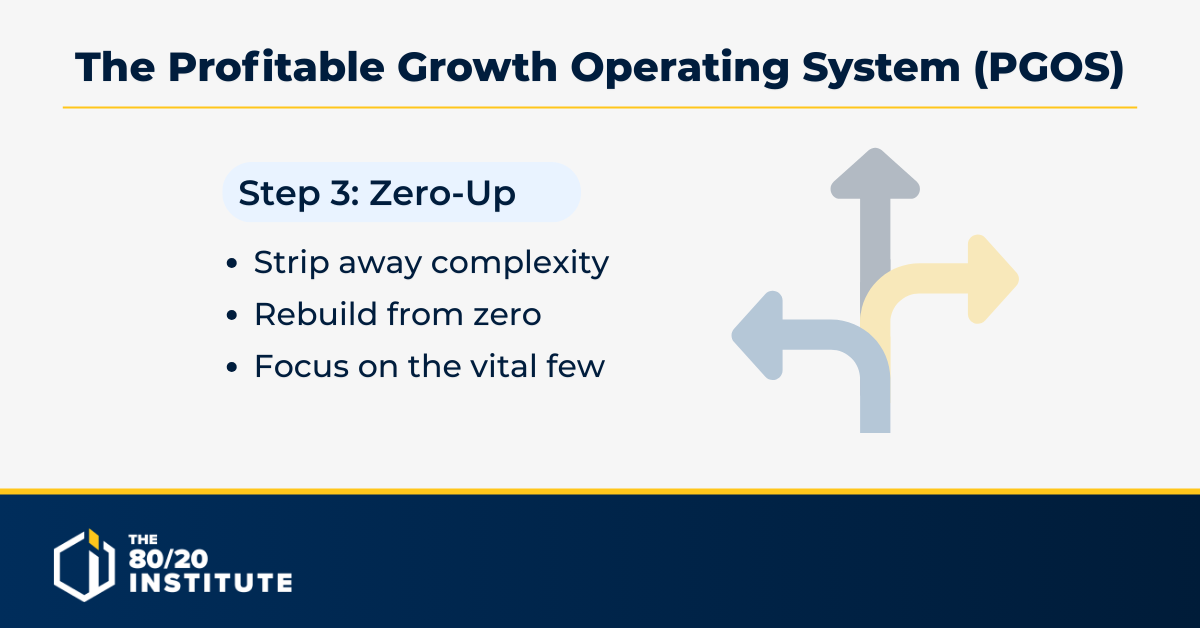
Your business carries weight. Products, customers, services, and processes accumulate over time—some vital, others quietly draining resources. Your job is to separate what truly drives profitability from what merely creates activity. That’s what Zero-Up does.
Zero-Up rebuilds your business model from the ground up. Instead of asking, “Where can we cut?” you ask, “If we started fresh today, what would this look like?”. The exercise strips away legacy complexity and reveals a future state where resources are concentrated on what matters most.
There isn’t one “perfect” way to Zero-Up. The right method is the one that gives you the clearest view and guides profitable action. The two most useful approaches are:
- Zero-Up by Quadrant
- Zero-Up by Product/Customer Inflection Point
Whichever you use, the outcome is remarkably consistent: a small fraction of customers and products generate the majority of profit, while the rest consume disproportionate resources. The 80/20 pattern shows up every time.
Zero-Up by Quadrant
Start with your most recent 80/20 Treasure Map:
- Quad 1 (Fort): A customers buying A products
- Quad 2 (Necessary Evil): A customers buying B products
- Quad 3 (Transactional): B customers buying A products
- Quad 4 (Problem Area): B customers buying B products
Build a stand-alone P&L for Quad 1 as if it were the entire company: revenue, gross margin, and then allocate payroll, manufacturing overhead, SG&A, and other costs until you reach operating profit. You’re modeling the business you would run if you only served the Fort.
Repeat the exercise for Quads 2 and 3. Track spend and headcount. You’ll end with three “future-state” P&Ls you can compare side-by-side.
Here’s what we see again and again: Quad 1 requires fewer resources and produces 150–200% of current total profits, while Quads 2 and 3 contribute more modestly, and Quad 4 destroys value unless repriced or exited. The path forward becomes obvious: concentrate on Quads 1–2, run Quad 3 transactionally, and minimize/exit Quad 4.
Zero-Up by Product / Customer Inflection Point
This top-down method ranks customers by revenue (or profit), then models profitability account by account. For each, you assign the minimum required costs, materials, payroll, overhead, SG&A, and down to EBITDA.
As you move down the list, cumulative EBITDA rises, flattens, then declines. The point where the curve turns down is your inflection point—the line between customers who add value and those who erode it.
Re-ranking customers by individual EBITDA gives you a more accurate picture. The bell-curve peak indicates where profit maximization ends; everything to the right reduces results and neccesitates a different operating model (transactional terms, automation, or exit).
What Zero-Up Reveals (and why it sticks)
- Focus beats breadth. A small set of customers/products carries the business.
- Cost-to-serve matters. Many “good” accounts are unprofitable once fully loaded.
- Operating rules need to change. Fort accounts warrant top talent and investment; others need transactional treatment and clear guardrails.
In our client work, Zero-Up has consistently demonstrated that the Fort alone can deliver 150–200% of current profits, while Quad 4 (and parts of 3) quietly destroy margins. Once leaders see the future-state P&Ls, resource shifts, coverage models, and pricing moves become straightforward, and results follow quickly.
The Bottom Line
Zero-Up is a blueprint for profitable growth. Whether you do it by Quadrant or by Inflection Point, the exercise gives you a fact-based model of the future state where resources are concentrated on what drives results and stripped from what erodes them. That clarity turns tough choices into obvious ones.
The Profitable Growth Accelerator™ (PGA) is how we install this discipline in 100 days—running Zero-Up with your data, aligning leadership on the future state, and locking in the operating rules that protect profit.
Book a Discovery Call to run Zero-Up on your business, clarify your future state, and chart the most direct path to profitable growth.